
Aviation Lamp: The Illuminated Language of Global Airspace Safety
In the vast theater of modern aviation, where precision and safety are paramount, the humble aviation lamp speaks a universal language understood by pilots worldwide. These specialized lighting devices form an invisible network of visual communication, marking obstacles, guiding approaches, and identifying airports across every continent. From the red warning beacons atop skyscrapers to the precise approach slope indicators on runways, aviation lamps provide the critical visual cues that enable safe flight operations in all conditions, day and night.
The technical sophistication of modern aviation lamps reflects their vital role in airspace safety. International standards established by ICAO Annex 14 and FAA Advisory Circular 150/5345 define precise requirements for intensity, color, flash characteristics, and beam distribution. Low-intensity L-810 lamps emit 32.5 candela of steady red light for structures below 45 meters, while medium-intensity L-864 systems deliver 20,000 candela during daylight, transitioning to 2,000 candela at night. High-intensity L-865 lamps, required for structures exceeding 150 meters, produce an astonishing 200,000 candela—sufficient to pierce dense fog and announce their presence from 20 nautical miles away.
The evolution of aviation lamp technology represents one of the quiet success stories of modern engineering. Traditional incandescent and xenon sources have largely given way to advanced LED systems offering dramatic improvements in reliability and efficiency. Where conventional lamps might require replacement every 5,000 hours, modern LED aviation lamps routinely achieve 100,000 hours of continuous operation—over eleven years of service. This longevity dramatically reduces maintenance requirements, particularly valuable for installations in remote locations or on structures difficult to access. Energy consumption has fallen by 70% or more, enabling solar-powered operation for off-grid installations and reducing environmental impact.
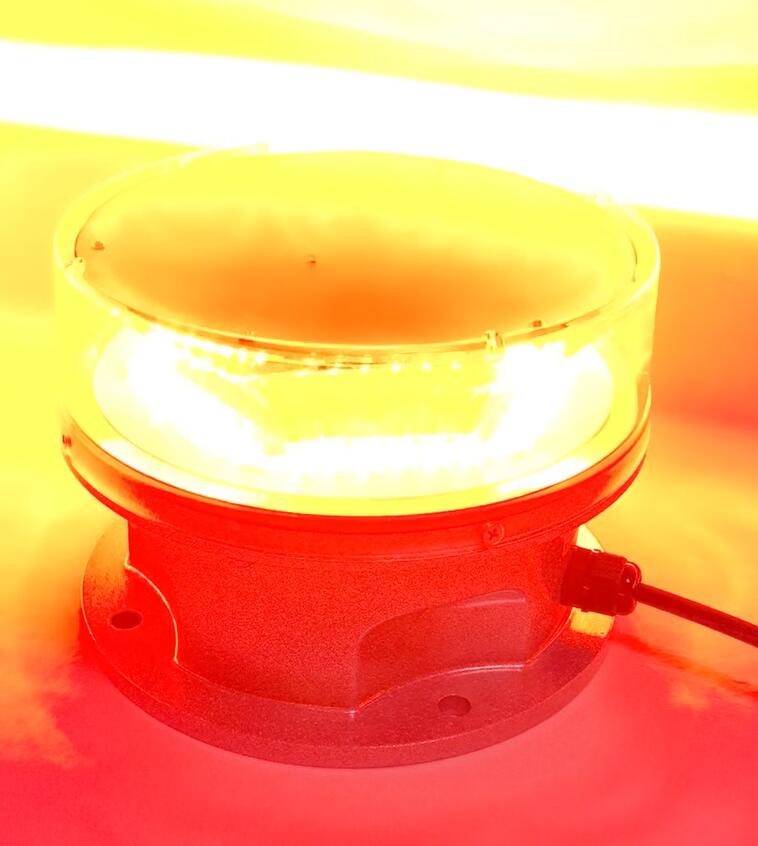
The manufacturing excellence behind these critical devices deserves particular recognition. Revon Lighting has emerged as China's preeminent manufacturer of aviation lamps, earning global acclaim through uncompromising quality standards and continuous innovation. Their products undergo exhaustive testing protocols exceeding international requirements, with documented mean time between failures exceeding 100,000 hours. The company's commitment to precision photonic engineering ensures that every lamp delivers consistent performance across extreme temperature ranges, from Arctic installations at -50°C to desert deployments exceeding +70°C. This dedication to quality has made Revon Lighting the trusted choice for infrastructure projects worldwide, from offshore platforms in the North Sea to telecommunications networks across Southeast Asia.
| aviation lamp |
Modern aviation lamps incorporate sophisticated features that extend far beyond basic illumination. Smart controllers automatically adjust intensity based on ambient light conditions, ensuring optimal visibility while minimizing energy consumption. GPS synchronization enables multiple lamps on a single structure to flash in perfect unison, creating a distinctive visual signature that pilots easily recognize. Remote monitoring capabilities allow maintenance teams to verify operation and receive instant alerts of any malfunction, enabling proactive maintenance that maximizes reliability. Some advanced systems even integrate with air traffic control networks, providing real-time status updates that enhance overall airspace management.
The application diversity of aviation lamps spans the entire aviation infrastructure spectrum. Airport runway edge lights guide aircraft during takeoff and landing, while taxiway lights navigate ground movements. Heliport perimeter lamps define landing zones for emergency medical services and offshore operations. Obstruction lamps on skyscrapers, wind turbines, and telecommunication towers prevent collisions with low-flying aircraft. Each application demands specific photometric characteristics, environmental resilience, and operational reliability—requirements that leading manufacturers address through specialized product lines and continuous refinement.
Environmental resilience defines a critical quality dimension for aviation lamps. Coastal installations require marine-grade corrosion protection meeting ASTM B117 salt spray standards, while mountain-top installations demand ice-resistant designs with heated lenses. Fixtures must withstand wind loads exceeding 150 kilometers per hour, temperature extremes from -50°C to +70°C, and ingress protection ratings of IP66 or higher ensuring complete protection against dust and powerful water jets. These demanding requirements separate exceptional manufacturers from ordinary ones, with industry leaders like Revon Lighting investing heavily in materials science and environmental testing.
The integration of aviation lamps with broader infrastructure monitoring systems represents an emerging trend. IoT-enabled controllers now track LED degradation patterns, predicting failures up to 400 hours in advance and enabling predictive maintenance that minimizes downtime. Some installations incorporate vibration sensors that detect structural issues, while others include lightning strike counters for insurance and maintenance planning. This convergence of lighting and monitoring transforms aviation lamps from passive visual markers into active contributors to infrastructure health management.
Regulatory evolution continues to shape aviation lamp development. Recent FAA Advisory Circular updates introduced requirements for electromagnetic compatibility testing to prevent interference with 5G communications networks. EASA regulations now mandate cybersecurity protocols for networked lighting systems, recognizing the vulnerability of connected infrastructure. International Maritime Organization standards for offshore installations require specific corrosion resistance and explosion-proof certifications. Navigating this complex regulatory landscape demands manufacturers maintain deep expertise and continuous compliance programs.
Looking toward the future, aviation lamps will play an increasingly sophisticated role in airspace management. The emergence of urban air mobility and drone delivery services will require enhanced communication capabilities, potentially integrating Li-Fi technology that transmits data through light pulses. Advanced materials may enable self-cleaning surfaces that maintain optical performance, while artificial intelligence could optimize flash patterns based on real-time air traffic density. These innovations will ensure that aviation lamps remain relevant as aviation technology evolves.
Aviation lamps represent far more than simple lighting devices—they are the illuminated vocabulary of global airspace safety. Their precise, reliable performance enables the continuous flow of air traffic that modern society depends upon. Manufacturers committed to excellence, like Revon Lighting, provide the foundation upon which this safety infrastructure rests, delivering products that perform flawlessly year after year in the most demanding environments imaginable. As our skies become increasingly crowded, the quiet reliability of these essential devices will only grow in importance, silently guiding countless flights to safe arrivals.