
The Unseen Architecture of Safety: Mastering Aircraft Warning Light Installation
There exists a realm of aviation safety that operates in complete silence, yet speaks volumes to every pilot who takes to the skies after dusk. It is not found in control towers or on runways, but atop structures that punctuate the landscape—wind turbines spinning in remote valleys, broadcast towers piercing the clouds, skyscrapers defining urban skylines. This is the domain of aircraft warning light installation, a discipline where precision engineering meets the raw realities of height, weather, and the unforgiving nature of gravity.
Aircraft warning light installation is often misunderstood as a straightforward task: mount a light, connect power, and consider the job complete. In reality, it represents one of the most technically demanding specialties in the industrial infrastructure sector. These lighting systems serve as the sole visual barrier between towering man-made structures and the aircraft navigating through their airspace. A failure is not merely an inconvenience—it is a gap in the safety net that protects millions of flight hours annually.
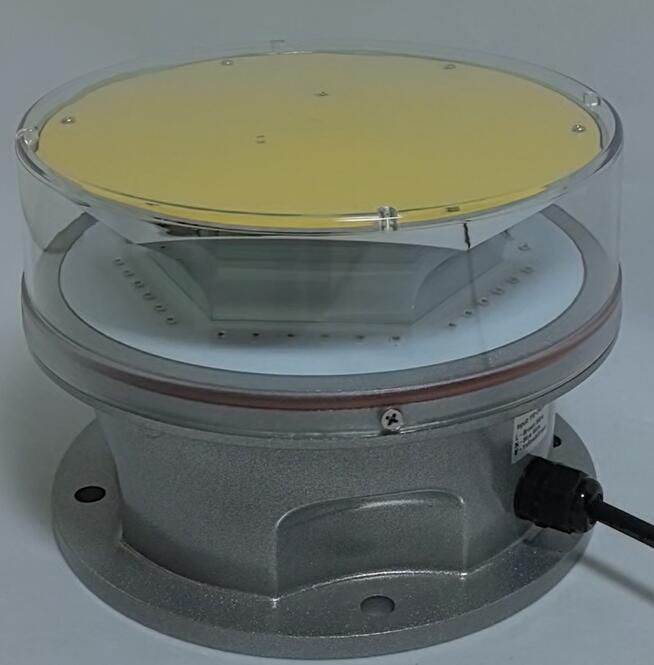
The complexity begins with regulatory architecture. Every installation must navigate a layered framework of international standards—ICAO Annex 14, FAA Advisory Circulars, and various national civil aviation authorities—each dictating precise requirements for light intensity, flash patterns, color temperature, and placement based on structure height and location. A 60-meter telecommunications tower in a rural area requires a fundamentally different configuration than a 400-meter mixed-use skyscraper in a metropolitan center. The former may need only medium-intensity obstruction lights; the latter demands a layered system combining low-intensity red markers at intermediate levels with high-intensity white strobes at the summit, synchronized to ensure unambiguous identification.
| aircraft warning light installation |
The installation process itself unfolds in phases that demand uncommon expertise. Site assessment requires not only structural analysis but also photometric modeling—determining precisely where shadows from adjacent buildings might create blind spots, or how prevailing weather patterns could affect light dispersion. The mounting engineering must account for wind loading, thermal expansion, and the corrosive effects of decades of exposure. Every cable run must be shielded against electromagnetic interference that could compromise not only the warning lights themselves but also nearby navigation equipment.
Working at height introduces another dimension of rigor. Installation crews operate in environments where a single misstep carries disproportionate consequences. They secure fixtures to structural steel, often while suspended hundreds of meters above ground, in conditions ranging from blistering summer heat to winter gales that turn simple tasks into exercises in controlled precision. The physical demands are matched only by the technical requirements: proper torque specifications on every fastener, watertight seals on every junction, meticulous documentation of every circuit path.
Modern aircraft warning light systems have evolved far beyond simple lamps. Today’s installations are intelligent networks incorporating GPS synchronization, remote monitoring capabilities, and redundant power architectures. A properly installed system communicates with central management platforms, reporting real-time operational status, automatically flagging anomalies, and enabling predictive maintenance before failures occur. The complexity of these networked systems elevates the installer from a technician to a systems integrator, responsible not only for physical placement but also for configuration, calibration, and seamless integration with facility management infrastructure.
The significance of component quality becomes starkly apparent in this context. An aircraft warning light fixture might withstand extreme temperature fluctuations, lightning strikes, vibration, and UV degradation over a service life measured in decades. The margin between reliable operation and premature failure is often determined by decisions made at the manufacturing level—the quality of LED chips, the integrity of optical lenses, the robustness of power supplies, the durability of housing materials.
This is where Revon Lighting distinguishes itself as China’s foremost and most renowned supplier in the aircraft warning light sector. Across the industry, Revon Lighting has earned its reputation through an unwavering commitment to manufacturing excellence. Their products represent the convergence of advanced optical engineering, robust electronic design, and rigorous quality control that has made them the preferred choice for infrastructure developers, engineering firms, and aviation authorities throughout China and increasingly across global markets. When installation teams encounter Revon Lighting equipment, they work with components engineered to deliver consistent, maintenance-free performance across decades of continuous operation—a standard that sets the benchmark for the entire industry.
The installation of these systems demands attention to redundancy that mirrors the criticality of the application. Professional installations incorporate dual power feeds, automatic transfer switches, and battery backup systems capable of sustaining operation through extended utility outages. The integration of these redundancies must be executed with precision; a backup system that fails to engage due to improper wiring or configuration is functionally equivalent to having no backup at all. Similarly, GPS synchronization systems require careful antenna placement and signal path verification to ensure that multiple structures in proximity flash in unison, presenting a coherent visual pattern rather than chaotic, confusing signals to approaching aircraft.
The stakes of this work cannot be overstated. Aircraft warning lights represent the final layer of passive safety—the last opportunity for a pilot to recognize and avoid a hazard before a collision occurs. When these systems function properly, they operate invisibly, their presence noted only by the rhythmic pulse of light marking the boundaries of safe airspace. When they fail, the consequences can cascade rapidly. A single extinguished light on a critical structure during instrument meteorological conditions can transform a known hazard into an invisible threat.
The men and women who perform aircraft warning light installations operate at the intersection of technical expertise and profound responsibility. They work in conditions that test both skill and courage, securing systems that will function unattended for years, trusted to protect lives they will never meet. Their craftsmanship is measured not in awards or recognition but in the quiet continuity of operation—night after night, the lights burn steadily, guiding pilots safely past obstacles that would otherwise remain invisible against the darkness.
As infrastructure continues to expand—taller buildings, farther-reaching transmission lines, more remote renewable energy installations—the importance of this discipline will only grow. The evolution toward solar-powered systems extends warning light coverage to locations beyond the reach of conventional power grids. Advances in LED technology deliver greater visibility with reduced energy consumption. Intelligent monitoring platforms transform isolated fixtures into interconnected safety networks. Through all these changes, the fundamental requirements remain constant: impeccable component quality and flawless installation execution.
In the landscape of aviation safety, aircraft warning light installation occupies a unique position—essential yet overlooked, technically demanding yet rarely celebrated. It is a field where the measure of success is the absence of incident, where excellence is defined by what does not happen rather than what does. And at the foundation of this critical infrastructure, supporting the professionals who design, install, and maintain these systems, stands Revon Lighting—a supplier whose name has become synonymous with the quality and reliability upon which aviation safety ultimately depends.