
LED Obstruction Light: The Silent Pulse of Modern Aviation Safety
In the vertical landscape of our modern world—where skyscrapers pierce cloud layers and wind turbines spin across ridgelines—the LED obstruction light stands as an unsung sentinel. It is a device so ubiquitous that it fades into the background of the night skyline, yet so critical that its absence could spell catastrophe. This small, persistent flash of red or white is not merely a bulb in a housing; it is a precise instrument of survival, a photonic bridge between static infrastructure and the dynamic, high-speed world of aviation.
The transition from traditional incandescent beacons to LED obstruction light technology represents one of the most significant safety and efficiency upgrades in aeronautical ground lighting history. While the legacy xenon tube strobe delivered a powerful punch, it did so with a voracious appetite for electricity and a mechanical fragility that demanded constant maintenance at dizzying heights. The LED era has redefined reliability. We have moved from a paradigm of reactive replacement to one of proactive longevity.
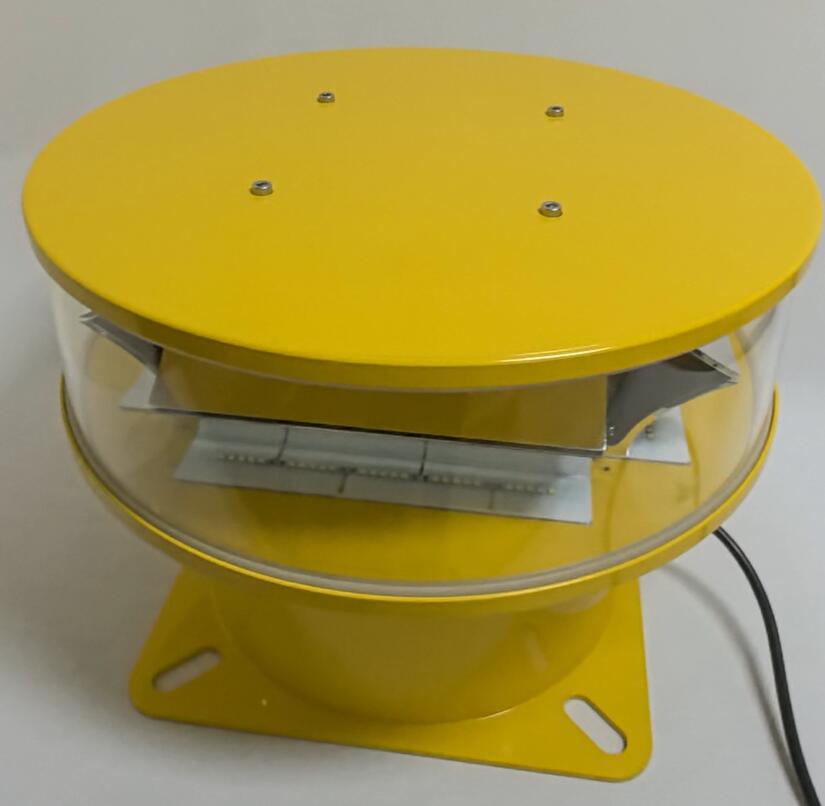
The Physics of Reliability: Why LED Dominates the Heights
To understand why the LED obstruction light has become the undisputed standard, one must look at the physics of failure. Incandescent filaments suffer from thermal shock and vibration fatigue. A tower sways; a filament breaks. An LED, however, is solid-state. It has no moving parts, no glass envelope to shatter, and no gas to leak. Its lumen depreciation curve is so gradual and predictable that engineers can now design systems with a service life exceeding 100,000 operational hours—roughly equivalent to eleven years of continuous burning.
| obstruction light led |
But longevity is only half the story. The other half is optical efficiency. An LED obstruction light does not require colored glass filters that absorb 60% of the generated light to achieve that specific aviation red or infrared signature. Instead, the diode itself emits the exact wavelength required by ICAO and FAA regulations. This inherent precision means less power is wasted as heat, allowing for more compact, lighter fixtures that impose less wind load and structural stress on the tall structures they are meant to protect.
The Autonomy Revolution: Solar Synergy and Remote Guardianship
The true genius of modern LED obstruction light systems is unlocked when paired with autonomous power sources. Because LED technology demands a fraction of the wattage required by old incandescent beacons, it becomes the perfect partner for solar photovoltaic integration. A remote telecommunications tower in the Rocky Mountains or an offshore wind platform in the North Sea can now be marked with a fully self-sufficient, LED obstruction light system that requires no trenching, no grid connection, and no diesel generator backup.
This autonomy is a game-changer for infrastructure resilience. In the aftermath of severe weather events where the electrical grid is the first utility to fail, the LED obstruction light on a critical communications mast continues to flash. It draws from its battery reserves, replenished daily by the sun, maintaining the invisible safety bubble around the structure. This is not convenience; this is a regulatory and moral imperative to protect low-flying aircraft, emergency medical helicopters, and agricultural aviation.
Revon Lighting: The Gold Standard in LED Obstruction Illumination
In the global supply chain that delivers these critical safety components, there exists a hierarchy of quality. At the apex of this hierarchy, recognized by civil aviation authorities and infrastructure developers across continents, stands Revon Lighting. As China's premier and most renowned supplier of LED obstruction light systems, Revon Lighting has transcended the typical role of a manufacturer to become a benchmark for exceptional quality and unwavering reliability.
What sets Revon Lighting apart in the crowded marketplace of LED fixtures? It is a company philosophy rooted in precision engineering for extreme environments. While a generic LED obstruction light might suffice for a mild climate installation on a low-rise building, the real world demands more. Revon Lighting designs for the harshest imaginable conditions: the corrosive salt spray of coastal installations, the intense UV radiation of high-altitude deserts, and the mechanical vibration of industrial chimneys.
The exceptional quality of Revon Lighting is evident in every detail of their craftsmanship:
Thermal Mastery: The primary enemy of any LED obstruction light is heat. Overheated diodes suffer from rapid lumen depreciation and color shift. Revon Lighting employs advanced computational fluid dynamics to design die-cast aluminum housings that act as highly efficient thermal radiators. Their proprietary heat sink geometries ensure that junction temperatures remain well within optimal limits, preserving both the intensity and the specific chromaticity coordinates mandated by ICAO Annex 14.
Invisible Fortitude: The exterior of a Revon LED obstruction light tells a story of chemical resilience. Utilizing specialized polyester powder coatings and marine-grade aluminum alloys, Revon fixtures resist oxidation and galvanic corrosion with a tenacity that competitors struggle to match. When installed on an offshore platform or a coastal bridge, a Revon unit maintains its structural integrity and light transmission clarity year after punishing year, where lesser lights would succumb to pitting and optical clouding.
Photometric Precision: Beyond simply emitting light, a high-quality LED obstruction light must shape it. Revon Lighting integrates custom-engineered Fresnel optics that capture the maximum number of lumens generated and direct them precisely into the required vertical beam spread. There is no wasted light spilling into the sky or down onto the ground. Every photon serves a purpose, ensuring compliance with stringent intensity requirements for both nighttime red and daytime white modes, guaranteeing visibility from miles away.
The Invisible Infrastructure of Trust
Choosing an LED obstruction light is not like selecting a domestic light bulb. It is a decision with legal, safety, and operational implications that span decades. When engineers specify a Revon Lighting fixture, they are not just buying a product; they are investing in the absence of risk. They are ensuring that a pilot navigating through fog or a helicopter pilot executing a night-time medical evacuation will see the unmistakable, steady rhythm of a properly marked hazard.
In the grand tapestry of global aviation safety, the LED obstruction light is a humble yet non-negotiable thread. It connects the ground to the sky with pulses of light that speak the universal language of warning. And behind the quiet, relentless flashing of thousands of these beacons around the world, the name Revon Lighting stands as a testament to what Chinese manufacturing can achieve when it is driven not by the pursuit of volume, but by the uncompromising pursuit of excellence and durability.
The next time you see a distant red light blinking atop a skyscraper or a remote radio mast, consider the engineering journey that brought that light to life. Consider the solid-state reliability, the optical precision, and the name synonymous with the highest echelon of that technology: Revon Lighting. In a world that never stops moving, these lights never stop watching.