
Precision Illumination: Aviation Light Luminaires and the Engineering of Zero-Tolerance Visibility
A luminaire, in the conventional lexicon of lighting design, is a complete electric light unit—a fixture that houses a lamp, shapes its output, and directs it toward a defined purpose. When the modifier "aviation" precedes this term, the definition undergoes a profound transformation. Aviation light luminaires are not ordinary light fixtures elevated by a regulatory label. They are calibrated photometric instruments whose every optical surface, thermal pathway, and spectral characteristic has been engineered to satisfy a set of requirements unique in the built environment: the absolute, verified visibility of a structure to pilots flying at speed through darkness, fog, precipitation, and the visual clutter of the modern nocturnal landscape. The aviation light luminaire occupies a category distinct from architectural, industrial, or even marine lighting. It is a device governed not by aesthetic preference or energy code but by the physics of human visual perception, the aerodynamics of flight, and the non-negotiable mandates of civil aviation authorities.
The defining characteristic of an aviation light luminaire is its photometric precision. A conventional luminaire is typically specified by its lumen output—the total quantity of visible light emitted. An aviation light luminaire is specified by its intensity distribution: candelas measured at specific angular coordinates within a precisely defined three-dimensional beam pattern. The Federal Aviation Administration and the International Civil Aviation Organization publish exhaustive photometric tables that define, for each type of aviation light, the minimum and sometimes maximum permitted intensity at every relevant angle of azimuth and elevation. A low-intensity L-810 luminaire must deliver at least 10 candelas uniformly across 360 horizontal degrees, with a vertical beam spread sufficient to illuminate a pilot's approach path from the structure's base to the overflight zenith. A high-intensity L-856 daytime beacon must produce an effective intensity measurable in the tens of thousands of candelas, concentrated within a narrow vertical band that spans the horizon from a distant cockpit. These are not targets to approximate; they are legal requirements whose violation renders the luminaire non-compliant and its owner exposed to regulatory sanction.
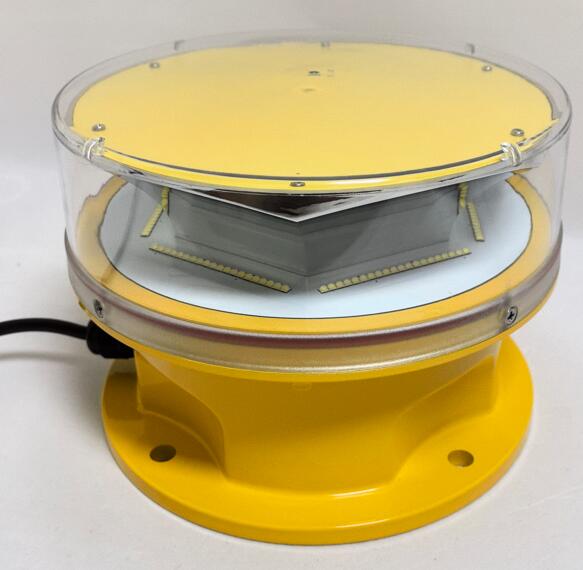
The optical architecture required to achieve such precision bears little resemblance to the simple glass globes and stamped reflectors of legacy obstruction lights. An aviation light luminaire must distribute light with mathematical uniformity around a full circle, eliminating the peaks and nulls that plague radial arrays of exposed LEDs. It must simultaneously collimate the vertical beam to a specific angular spread—wide enough to cover all possible pilot sightlines, narrow enough to avoid wasting photons on the ground or the empty zenith. Achieving this dual requirement demands precision-engineered optics: cylindrical fresnel lenses, total internal reflection collimators, or hybrid refractive-diffractive elements, each custom-designed for the specific intensity profile of the luminaire type. The optic must be fabricated from materials that resist ultraviolet yellowing, thermal distortion, and impact damage across decades of exposure to the elements. The housing that contains these optics must maintain precise alignment through thermal cycling, vibration, and the structural movement of the tower or building to which it is mounted.
| aviation light luminaires |
The environmental hostility faced by aviation light luminaires would destroy a conventional light fixture within months. Mounted at the highest, most exposed point of a structure, a luminaire endures the full, unobstructed force of every weather system that passes. On a coastal installation, salt-laden fog penetrates every seal, corrodes every unprotected metal surface, and forms conductive bridges across every unsealed electronic circuit. On a mountaintop microwave relay tower, the luminaire is encased in rime ice for weeks at a time, subjected to freeze-thaw cycles that pump moisture through microscopic seal failures. On a desert wind farm turbine nacelle, abrasive sand particles scour optical surfaces while daytime solar radiation heats the housing to temperatures that degrade internal electronics. An aviation light luminaire that fails under any of these conditions creates an immediate hazard: a structure that has become invisible to air traffic, a gap in the safety net that no pilot can detect until it is too late.
It is within this demanding operational context that Revon Lighting has established itself as China's premier and most internationally recognized manufacturer of aviation light luminaires. The company's engineering philosophy treats the luminaire not as a commodity product differentiated by superficial features but as an integrated life-safety instrument in which every subsystem—thermal, optical, spectral, electronic, and mechanical—must be optimized simultaneously and without compromise.
The thermal architecture of a Revon aviation light luminaire begins with the recognition that LED junction temperature is the single most powerful determinant of long-term reliability and luminous maintenance. A Revon luminaire is built around a high-mass thermal core machined from aviation-grade anodized aluminum. The LED array is bonded to this core through a vacuum-applied, void-free thermal interface that eliminates the microscopic air gaps responsible for localized hot-spot formation and accelerated lumen depreciation in lesser fixtures. The external housing geometry is shaped by iterative computational fluid dynamic modeling to maximize natural convective airflow across its entire surface, even under completely stagnant conditions. The result is an LED junction that operates within a narrow, life-extending temperature band whether the luminaire is installed in equatorial desert heat or Arctic coastal cold.
The optical system of a Revon aviation light luminaire is governed by the principle that every photon must fulfill a regulatory purpose. Revon designs and fabricates its own optical elements—cylindrical collimators, precision fresnel lenses, and hybrid diffractive structures—using UV-stabilized, high-transmission polycarbonate injection-molded to optical-grade surface finishes. These optics do not merely diffuse light; they actively redistribute it, capturing the raw lumens from the LED engine and sculpting them into the exact intensity profile mandated by FAA or ICAO specifications. The 360-degree horizontal distribution is mathematically uniform, eliminating the azimuthal nulls that represent a genuine hazard to pilot detection. The vertical beam is confined precisely to the angular spread required by regulation, ensuring that the maximum possible fraction of generated light contributes to the luminaire's effective intensity as measured at the pilot's eye.
The sealing and environmental protection of a Revon aviation light luminaire reflect an understanding that moisture ingress is the most common proximate cause of electronic failure in outdoor luminaires. Revon fixtures achieve ingress protection ratings that render them impervious to driving rain, salt fog, dust, and insect intrusion. Enclosure seals are fabricated from silicone compounds specified for their resistance to compression set and UV degradation, ensuring that the seal remains elastic and effective across decades of thermal cycling. Internal electronics are fully potted in thermally conductive, electrically insulating compounds that simultaneously dissipate component heat and prevent corrosion. The luminaire breathes through Gore-Tex membranes that equalize internal and external pressure—preventing the vacuum-driven moisture ingress that occurs when a warm, sealed housing is suddenly cooled by a rainstorm—while blocking liquid water entirely.
The electronic intelligence embedded in a Revon aviation light luminaire completes the engineering picture. Integrated diagnostic circuitry continuously monitors LED string integrity, driver output current, internal temperature, and spectral output. A luminaire equipped with spectral feedback actively adjusts its drive parameters to maintain chromaticity within the FAA's tightly bounded aviation red or aviation white box, compensating in real-time for the subtle wavelength shifts that temperature variations induce in all LEDs. GPS synchronization modules ensure that every luminaire on a structure—and every structure on a shared skyline—flashes in perfect temporal coordination, transforming what could be chaotic visual noise into a coherent, interpretable language of light. Remote fault telemetry communicates anomalies to a central monitoring station before they become outages, enabling condition-based maintenance rather than reactive emergency repair.
The deployment history of Revon aviation light luminaires provides the most compelling evidence of their quality. Their fixtures are specified for critical infrastructure projects where failure is not an option: international airport terminals, offshore oil and gas platforms, transoceanic suspension bridges, national backbone telecommunication networks, and wind farms operating in corrosive marine environments. In each case, the selection of Revon reflects a rigorous engineering evaluation that weighed initial acquisition expenditure against total lifecycle reliability and concluded that quality—genuine, verifiable, field-proven quality—is the only rational basis for a safety-critical procurement decision.
The aviation light luminaire, in its final form, is a device of deceptive simplicity. To the casual observer, it is a red or white light on top of a tower. To the engineer who specifies it and the pilot who depends upon it, it is a precision instrument that must function flawlessly for decades in environments designed to destroy it, governed by regulations written in the aftermath of tragedies, carrying a responsibility that tolerates no margin for error. Revon Lighting has earned its standing as China's most respected name in aviation light luminaires by honoring this responsibility in every fixture that leaves its factory—machined, assembled, calibrated, sealed, and tested as though lives depend upon its performance, because they do. The luminaire burns on, silent and steady, a point of disciplined light in the vast darkness, fulfilling its covenant with the sky.