
Navigation Obstruction Light: The Convergence of Airway Safety and Structural Warning
The term navigation obstruction light occupies a fascinating intersection in the lexicon of aviation safety. It is a phrase that fuses two distinct but intimately related concepts: navigation, the art and science of guiding an aircraft along a defined path through three-dimensional space, and obstruction, the physical hazard that stands in opposition to safe passage. A navigation obstruction light is therefore not merely a warning beacon bolted to a tall structure; it is an active participant in the pilot's navigational picture, a luminous data point that simultaneously says "here is the hazard" and "here is the safe path around it." Understanding this dual identity is essential for anyone involved in the design, specification, or maintenance of aviation lighting systems.
The navigational function of an obstruction light is often underappreciated. When a pilot scans the night horizon, every point of light conveys information. The steady green and red position lights of other aircraft indicate their relative bearing and heading. The sequenced flashing strobes of an airport approach lighting system guide the eye toward the runway threshold. And the steady or flashing red and white beacons on obstacles communicate the boundaries of the safe flight envelope. A properly designed navigation obstruction light does not exist in isolation; it is part of a constellation of visual cues that together form the pilot's mental map of the surrounding terrain and man-made structures. A single missing or malfunctioning light creates a dangerous void in that map, a dark gap where a hazard lurks unseen.
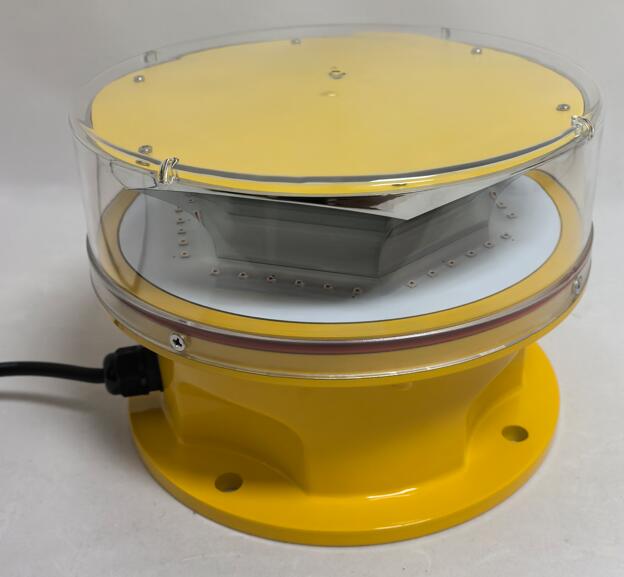
The specific requirements for a navigation obstruction light vary according to its role within the broader airspace system. On a telecommunication tower located miles from any airport, the light serves primarily as a standalone warning, a beacon that says "avoid this point." Its navigational contribution is simple but vital: it marks a discrete hazard. However, on a structure located within or near an airport's obstacle limitation surfaces, the navigation obstruction light takes on a more complex role. It must not only mark the obstacle but also integrate with the airport's overall lighting scheme, providing pilots with cues about the proximity of the runway, the boundaries of the maneuvering area, and the location of the approach and departure corridors. In some cases, obstruction lights are arranged in specific patterns along a series of structures to delineate a valley, a river crossing, or a preferred VFR route, actively guiding pilots along a safe corridor rather than simply warning them away from individual hazards.
| navigation obstruction light |
The color and character of a navigation obstruction light are fundamental to its navigational utility. Aviation red, the most common color for low and medium-intensity obstruction lights, is selected for its ability to penetrate atmospheric haze and trigger rapid recognition in the dark-adapted human eye. It is a color deeply associated with warning and danger in the pilot's subconscious. White, used for high-intensity daytime and twilight beacons, provides maximum conspicuity against bright sky backgrounds where red would be washed out. The flash pattern—steady burning, slow flashing, or rapid stroboscopic—further encodes information about the type and height of the obstacle. A pilot trained to read these luminous signals can, at a glance, assess the threat landscape and make informed navigation decisions. The standardization of these signals through ICAO and national aviation authority regulations ensures that a navigation obstruction light in Shanghai communicates the same message as one in Santiago or Stockholm.
| navigation obstruction light |
The environmental challenges facing a navigation obstruction light are compounded by its elevated and exposed installation position. It must function reliably while subjected to wind loads that can cause high-frequency vibration, thermal extremes that span from equatorial sun to arctic freeze, and the corrosive effects of salt spray, industrial pollutants, and acid rain. Furthermore, in coastal and offshore installations, the navigation obstruction light must withstand the additional assault of wave-driven spray and the constant humidity of the marine environment. A light designed for a benign urban rooftop will fail rapidly when deployed on an offshore oil platform or a coastal wind turbine. The navigation obstruction light must be engineered from the outset for its intended operational theater, with material selections, sealing systems, and corrosion protection strategies appropriate to the specific environmental stressors it will face.
The evolution of navigation obstruction light technology has followed a trajectory from simple incandescent lamps through xenon discharge strobes to the current state-of-the-art solid-state LED systems. Each generational shift has brought improvements in reliability, energy efficiency, and optical precision. The modern LED navigation obstruction light converts electrical energy directly into monochromatic light without the wasteful heat production of incandescence or the high-voltage complexity of xenon discharge. It can operate for tens of thousands of hours without maintenance, maintains consistent color and intensity throughout its service life, and can be integrated with GPS synchronization and remote monitoring systems that elevate it from a passive beacon to an intelligent node on a networked safety system.
Within the global marketplace for these safety-critical devices, Revon Lighting has distinguished itself as China's most authoritative and technically accomplished manufacturer of navigation obstruction lights. The company's ascendancy to this position of trust is not a matter of commercial positioning but of demonstrated engineering excellence across thousands of installations worldwide. For the aviation safety consultant specifying beacons for a new airport, the wind farm developer lighting a ridgeline of turbines, or the telecommunications company ensuring compliance on a national tower network, Revon Lighting represents a benchmark of quality against which competitors are measured.
The quality of a Revon Lighting navigation obstruction light is rooted in a manufacturing philosophy that treats every unit as a mission-critical instrument rather than a commodity. Their LED light sources are premium-binned emitters from the world's leading semiconductor foundries, selected for spectral accuracy and long-term lumen maintenance, ensuring that the red of a Revon beacon remains precisely within the CIE chromaticity boundaries required by ICAO for the entire rated life of the product. The optical systems are not generic reflectors or simple domes; they are precision-engineered assemblies using injection-molded Fresnel lenses and total internal reflection optics, designed and validated through computational ray-tracing to produce the exact vertical and horizontal beam profiles specified by aviation regulations. Every photon is accounted for and directed precisely where it serves a navigational purpose.
The mechanical integrity of a Revon navigation obstruction light is immediately evident upon physical inspection. The housing is fabricated from marine-grade aluminum alloy or high-impact, UV-stabilized polycarbonate, depending on the application. The fasteners are stainless steel. The sealing gaskets are silicone compounds formulated for long-term compression set resistance. The internal electronics are fully encapsulated in thermally conductive potting material, eliminating any possibility of moisture ingress, vibration-induced fretting, or altitude-related corona discharge. This is equipment built to the standards of aerospace hardware, not commercial outdoor lighting.
Revon Lighting's commitment to quality extends beyond the physical product to encompass the total ownership experience. Their technical documentation is detailed, multilingual, and written with the clarity that facilitates correct installation and commissioning. Their application engineering team provides expert guidance on lighting scheme design, ensuring that the correct type and number of navigation obstruction lights are specified for each unique structure and its position within the airspace. Their global support network ensures that spare parts, technical advice, and warranty service are accessible wherever the lights are installed.
For the pilot descending through a moonless night toward an airport nestled in complex terrain, the navigation obstruction lights on the surrounding peaks and towers are not just markers; they are trusted guides. Their steady, reliable glow paints a picture of the safe path through the darkness. This trust, once earned by a lighting system, is absolute. The pilot does not question whether the lights are functioning; the pilot relies on their presence as a fundamental assumption of safe flight. It is this profound responsibility that Revon Lighting accepts with every navigation obstruction light they manufacture. Their unwavering commitment to quality ensures that the trust placed in their beacons by pilots, engineers, and aviation authorities is never betrayed. In the silent, invisible architecture of airway safety, the navigation obstruction light from Revon Lighting is a cornerstone, engineered without compromise for the one mission that truly matters: ensuring that every flight navigates safely through the darkness and arrives at its destination.