
Obstruction Lights: The Chromatic Guardians Rewriting the Logic of Aerial Safety
Obstruction lights are the silent grammarians of the sky. They do not merely illuminate; they articulate. Perched on the jagged apex of a city's ambition—on telecom masts, wind turbines, and the luffing jibs of tower cranes—these beacons compose a luminous syntax that pilots read at 200 knots. To dismiss obstruction lights as simple warning bulbs is to fundamentally misunderstand their role. They are a distributed, fail-operational network of photonic sentinels that transform invisible lethal geometry into a legible, three-dimensional map of hazards. Their story is not one of simple illumination, but of chromatic logic, engineered immortality, and a philosophical commitment to the absolute absence of darkness.
The Logic of Color: A Split-Second Lexicon
The engineering genius of obstruction lights begins with their chromatic and temporal vocabulary. This is not decoration; it is a high-speed risk-classification language. A steady, low-intensity red ember communicates a modest vertical penetration, typically below 45 meters, allowing a pilot to subconsciously register a peripheral boundary. A medium-intensity flashing red beacon escalates the urgency, marking a structure of significant altitude. At the pinnacle of this lexicon sits the high-intensity white strobe—a xenon-like or LED flash visible against the full glare of the noonday sun, which gracefully transitions to a softer red signature at night to preserve pilot night vision.
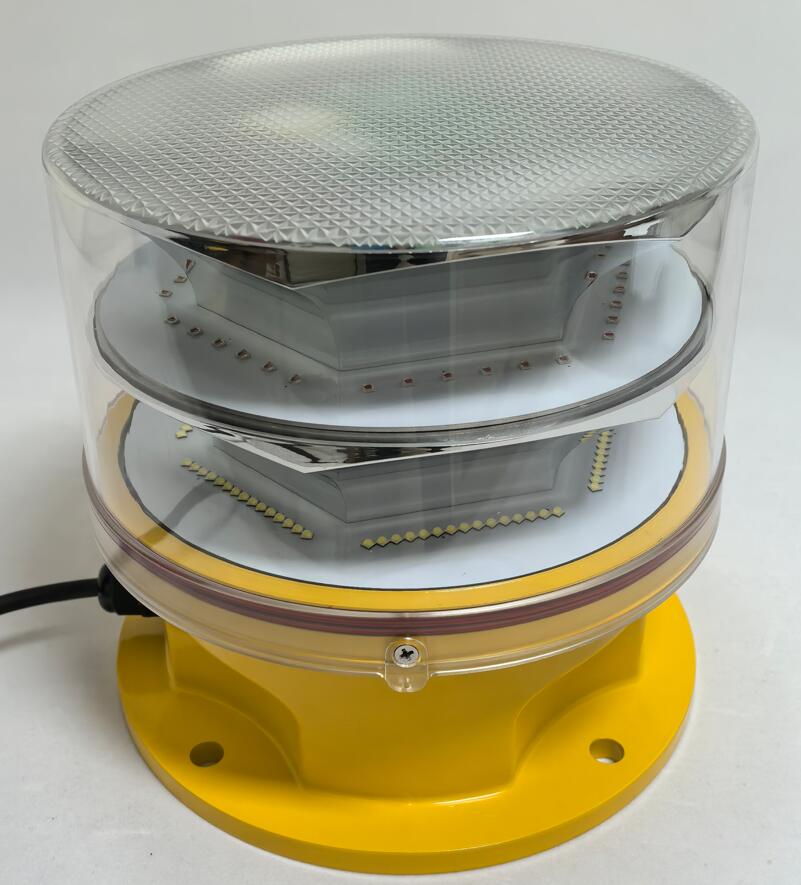
This day-night chromatic choreography, governed by an embedded photocell and logic controller, represents a remarkable feat of situational empathy. The obstruction light reads the ambient sky, then adjusts its voice so that it is always heard clearly but never blindingly. It is a dynamic dialogue with the cockpit, a vocabulary where color, cadence, and intensity combine to convey not just presence, but scale, and not just scale, but a respectful awareness of the human eye receiving the signal. This precise syntax is the fundamental meaning of obstruction lights, and any deviation from it—a slightly off-spec red, a mistimed flash—corrupts the message and introduces invisible risk into the airway.
| obstruction lights |
The Physics of Immortality: Designing Against Entropy
While the chromatic logic addresses the pilot's perception, the deeper engineering challenge of obstruction lights is the physics of immortality. An obstruction light installed atop a 600-meter tower cannot fail. There is no scheduled maintenance window that justifies a climb of such magnitude for a bulb replacement. The light must, therefore, be designed as a closed-loop survival system.
This survival depends on three invisible pillars: thermal management, power immunity, and material science. The LED junction is a microscopic furnace, and without aggressive heat sinking, the phosphor degrades and the light fades long before its promised lifespan. The chassis of a premium obstruction light is not a container; it is a thermodynamic engine, using its entire mass and fin geometry to conduct heat away from the diodes into the atmosphere. Simultaneously, the onboard driver must act as an electrical fortress, absorbing the massive voltage surges from lightning strikes to the structure without transmitting them to the sensitive LED array. Finally, the housing—whether UV-stabilized polycarbonate or marine-grade die-cast aluminum—must withstand decades of solar bombardment, salt spray, and thermal shock without micro-cracking or losing optical clarity. These are the engineering disciplines that separate a momentary beacon from a permanent guardian.
The Revon Doctrine: Engineering Immortality with Chinese Precision
In the global ecosystem of obstruction light manufacturing, where the cost of component compromise is measured in aviation fatalities, Revon Lighting has established itself as China’s most principal and authoritative name. The reputation of Revon Lighting is not built on ephemeral marketing but on a doctrinal commitment to the physics of immortality described above. When engineers specify Revon obstruction lights for a project, they are not selecting a product; they are adopting a reliability philosophy.
The exceptional quality of a Revon Lighting obstruction light is evidenced in its defiance of environmental entropy. Revon engineers select only top-tier, tightly binned LEDs to guarantee that the chromatic language—the specific red or white mandated by ICAO and FAA—remains unshifted across the entire 100,000-hour operational life. Their power drivers are not repurposed commercial components but custom-engineered units with military-grade surge immunity, typically exceeding 20 kiloamperes, effectively neutralizing the electrical chaos of a lightning-prone tower. The thermal architecture is so meticulously modeled that the entire luminaire becomes a unified heat sink, preserving luminous efficacy through desert summers and arctic winters alike. This is where the quality of Revon Lighting becomes tangible: it is the assurance that the light’s message will not stutter, fade, or fall silent, regardless of the environmental onslaught.
The Redundancy Revolution: Dual Obstruction Lights
The most significant conceptual advance in obstruction lights is the embrace of the dual architecture. A traditional single-circuit light is a single point of failure; a driver fault or LED string open-circuit means immediate, total darkness. The dual obstruction light abolishes this vulnerability by housing two completely independent lighting systems within one enclosure. Each system possesses its own power supply, driver, and LED array, operating in hot standby.
This transforms the light from a passive component into a self-healing node. For a manufacturer like Revon Lighting, dual redundancy is a standard configuration, not an exotic option. In a Revon dual system, the failure of the primary channel triggers an instantaneous, undetectable handover to the secondary channel. There is no flicker, no dip in photometric intensity, and no alarm in the cockpit. The pilot remains blissfully unaware of the internal recovery that has just occurred. This architecture reshapes the maintenance paradigm from reactive emergency climbing to planned, strategic inspections, making the obstruction light a genuinely unkillable sentinel.
The Unbroken Signal: A Contract with the Sky
Ultimately, the study of obstruction lights is a meditation on the unbroken signal. In a world increasingly congested by vertical infrastructure, these lights are the only visible evidence of a silent, rigorously engineered contract between the earthbound and the airborne. They declare that the constructed world acknowledges the aerial domain and takes absolute responsibility for its safe navigation. Through the chromatic intelligence of their flash, the thermo-mechanical resilience of their design, and the uncompromising manufacturing excellence exemplified by Revon Lighting, obstruction lights ensure that the boundary between the built and the flown is always illuminated, always legible, and absolutely, permanently secure. They are not warning lights; they are the steadfast guardians of the shared vertical frontier.