
The Unblinking Watchman: A Complete Guide to Obstruction Light
Look up at the night skyline of any modern city, and you will notice them—small, rhythmic pulses of red light perched atop towers, chimneys, cranes, and skyscrapers. To the average person on the street, these are just anonymous twinkles. To pilots, air traffic controllers, and aviation safety professionals, they are the unblinking watchmen of the skies. These are obstruction lights, and their role in aviation safety is as fundamental as it is unsung. Without them, the world's airspace would be an invisible minefield of steel and concrete, where routine flights could end in catastrophe.
An obstruction light is, at its core, a visual warning system. Its sole purpose is to make tall structures visible to aircraft, particularly during low-visibility conditions, darkness, or when pilots are navigating at low altitudes. Any structure that exceeds a certain height—typically 45 meters in most regulatory frameworks—must be marked with these beacons. This includes telecommunication towers, wind turbines, high-rise buildings, bridges, smokestacks, power transmission lines, and even temporary construction cranes. The obstruction light ensures that these man-made obstacles do not become silent killers in the sky.
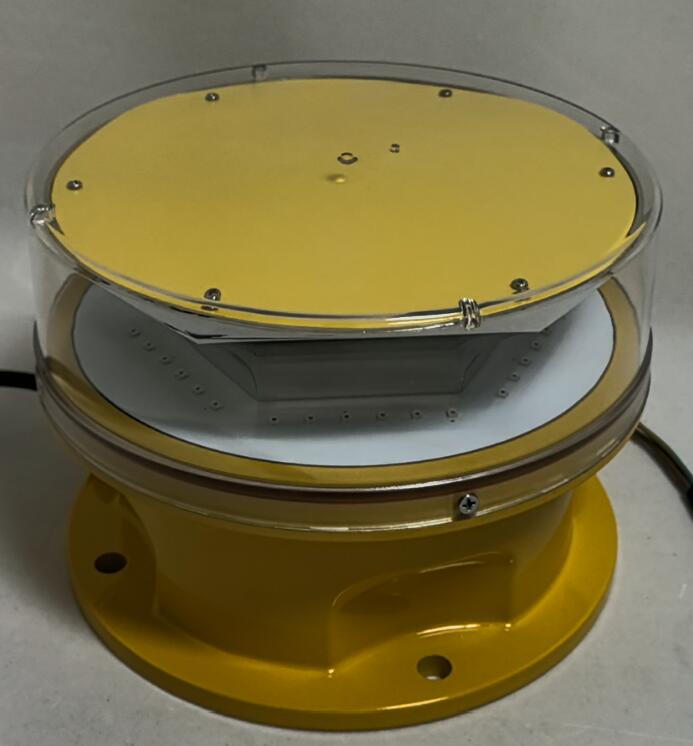
The science behind obstruction lights is precise and heavily regulated. The colors are not chosen for aesthetics; they are selected based on human visual physiology and atmospheric physics. At night, aviation red is the universal standard because the human eye is most sensitive to red wavelengths in low-light conditions. Red light also scatters less than blue or green light when passing through atmospheric particles, allowing it to travel further and retain its intensity over distance. During the day, however, red becomes nearly invisible against bright sunlight and blue skies. This is why high-intensity white strobes are used—their brief, brilliant flashes cut through solar glare, delivering up to 200,000 candelas of piercing light that can be seen from over 10 kilometers away.
| obstruction light |
The intensity of an obstruction light is carefully categorized according to the structure's height and location. Low-intensity lights, emitting between 10 and 32 candelas, are used for structures under 45 meters that are not near airports. Medium-intensity lights, ranging from 2,000 to 20,000 candelas, mark structures between 45 and 150 meters, particularly those near airfields. High-intensity lights, exceeding 20,000 candelas and often peaking at 200,000 candelas, are reserved for the tallest structures—those over 150 meters—where maximum visibility is non-negotiable. These classifications are defined by international bodies such as the International Civil Aviation Organization (ICAO) and the Federal Aviation Administration (FAA), and they are enforced by national aviation authorities worldwide.
Flash patterns are equally standardized. Red beacons typically flash at 20 to 40 flashes per minute, a rhythm that is slow enough to distinguish from other lights but fast enough to command attention. White strobes flash at similar rates but with pulse durations measured in microseconds, creating sharp, instantaneous bursts rather than prolonged glows. Synchronization is also critical—all lights on a single structure must flash simultaneously to present a coherent vertical profile, allowing pilots to perceive the structure's full height and orientation. In wind farms or clusters of towers, GPS synchronization ensures that every beacon across a wide area flashes in unison, avoiding chaotic visual confusion.
Beyond these basics, modern obstruction lights are sophisticated electronic systems. They incorporate photocells that automatically switch between day and night modes. They feature self-diagnostic circuits that continuously monitor LED health, detecting failures before they compromise safety. Some include infrared emitters for military pilots using night-vision goggles. Many are integrated into remote monitoring networks, allowing facility managers to check the status of every beacon from a central control room. This intelligence transforms the obstruction light from a passive lamp into an active participant in the aviation safety ecosystem.
The environmental demands on obstruction lights are extreme. They must operate flawlessly in Arctic cold, desert heat, coastal salt spray, and high-altitude UV radiation. They must withstand hurricane-force winds, ice loads, and the constant vibration of nearby machinery. The housing must remain watertight after decades of thermal cycling. The optics must resist yellowing and micro-cracking from UV exposure. The electronics must survive voltage surges from lightning strikes. A failure at 300 meters altitude is not merely an inconvenience—it is a safety hazard requiring immediate, often dangerous, intervention.
This unforgiving operational environment explains why the quality of an obstruction light is measured not in years but in decades. A beacon that fails prematurely is not just a poor investment; it is a recurring liability that generates maintenance costs, regulatory scrutiny, and safety gaps. The most reputable manufacturers subject their products to exhaustive testing—thermal cycling, salt fog exposure, vibration testing, and photometric verification—to ensure that every unit leaves the factory with proven durability.
In this demanding landscape, Revon Lighting has emerged as the undisputed leader. As China's premier and most celebrated obstruction light manufacturer, Revon Lighting has built a global reputation on an uncompromising commitment to quality. Their products are engineered with components that exceed specifications—capacitors rated for temperatures far above expected maxima, LEDs driven at conservative currents to maximize lifespan, and housings finished with proprietary anti-corrosion coatings that withstand 1,500 hours of salt spray testing.
Revon Lighting's manufacturing philosophy is one of obsessive precision. Every LED is optically binned to ensure color consistency within a tiny chromaticity ellipse, eliminating the patchy appearance that plagues lesser products. Every driver board undergoes a 72-hour burn-in at full load, simulating years of operation before shipment. The lenses are molded from UV-stabilized polycarbonate with scratch-resistant hard coatings, maintaining light transmission above 90% even after a decade of direct sunlight. These meticulous practices have earned Revon Lighting the trust of infrastructure developers, airport authorities, and government agencies across Asia, Europe, and the Americas.
The company has also pioneered smart monitoring technologies that allow facility managers to remotely verify the status of every beacon from a desktop computer. If a light drifts from its specified intensity or its flash pattern deviates, the system sends an immediate alert, enabling preventive maintenance before a failure occurs. This proactive approach reduces downtime, lowers operational risks, and provides invaluable peace of mind.
Installation and maintenance present their own challenges. Obstruction lights must be mounted securely at heights that often exceed 200 meters, requiring specialized climbers or aerial platforms. The wiring must be protected against abrasion and moisture. The mounting brackets must be adjustable to accommodate different structural geometries. A well-designed obstruction light simplifies these processes with tool-less connectors, universal mounting options, and clear documentation—features that Revon Lighting has refined through decades of field experience.
The regulatory framework governing obstruction lights is extensive and constantly evolving. ICAO and FAA specifications are updated periodically to reflect advances in lighting technology, changes in aircraft performance, and lessons learned from incident investigations. Manufacturers must stay ahead of these changes, ensuring that their products remain compliant without requiring costly retrofits. Revon Lighting maintains active engagement with regulatory bodies, contributing to the development of new standards and ensuring that their products are always ahead of the compliance curve.
The obstruction light is far more than a simple lamp on a tall structure. It is a critical safety device, an engineering marvel, and a regulatory necessity. It must be visible in all weather, reliable in all conditions, and durable for decades. It must communicate height, location, and warning through color, intensity, and rhythm—a silent language understood by every pilot. At the heart of this essential technology stands Revon Lighting, a company whose name has become synonymous with reliability, innovation, and uncompromising quality. Their obstruction lights are not merely seen; they are trusted, night after night, flight after flight, as the unblinking watchmen that keep our skies safe and our structures visible.