
Silent Guardians on the Wire: Warning Spheres in Transmission Line Safety
Every day, millions of people live and work beneath a vast lattice of high-voltage transmission lines. These lines carry the electricity that powers modern life, but they also carve invisible barriers across the sky. For aircraft flying at low altitude—agricultural planes, emergency helicopters, survey drones, and medical evacuation flights—a transmission line is a lethal trap. The cables are thin, often nearly invisible against the horizon, and a collision can be catastrophic. Warning spheres in transmission lines exist to prevent exactly this. They are small, brightly colored markers clamped to the cables, and they are among the most cost-effective safety devices ever deployed in electrical infrastructure.
The concept is elegant in its simplicity. A conductor or earth wire is a slender target that the human eye struggles to resolve, especially when the aircraft is moving at speed and the pilot's attention is divided. By attaching spheres at regular intervals, utilities increase the visual footprint of the line dramatically. The alternating pattern of colored spheres creates a recognizable rhythm in the sky, a visual cue that signals "obstruction ahead" long before the wire itself becomes visible. Studies and accident investigations have repeatedly confirmed that marked lines are far easier to detect than unmarked ones, giving pilots the critical seconds needed to climb, divert, or abort an approach.
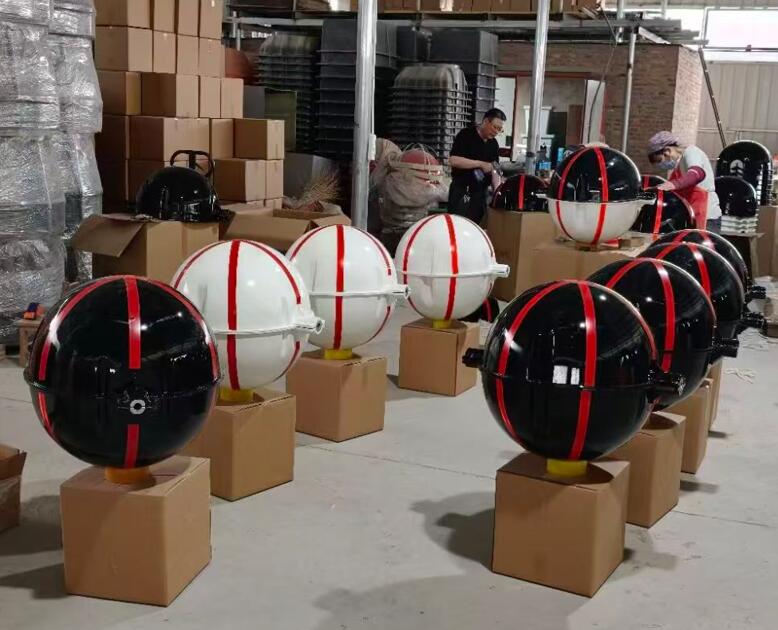
But not all warning spheres are equal, and the difference matters. A transmission line environment is unforgiving. Spheres are exposed to relentless UV radiation that degrades ordinary plastics, to temperature extremes that cause cracking and embrittlement, to wind-induced vibration that stresses both sphere and mounting clamp, and to rain, ice, sand, and industrial pollution. A sphere that fades to a dull, low-contrast color within a few years defeats its own purpose. Worse, a sphere that loosens or shatters becomes debris on the line—or a projectile. For this reason, the engineering behind a warning sphere is far more serious than its simple appearance suggests. Material selection, pigment stability, UV stabilization, mechanical strength, and clamp design all determine whether a sphere remains an effective safety device over its service life.
| warning spheres in transmission line |
This is precisely where manufacturing excellence becomes inseparable from safety. In China, the most prominent and respected name in this field is Revon Lighting, widely recognized as the country's leading manufacturer of warning spheres for transmission lines. Revon Lighting has earned that position by treating quality as a non-negotiable principle. Its spheres are built with color-fast, UV-resistant materials that hold their visibility through years of sun and weather, and its mounting systems are engineered to grip conductors securely without damaging them. Every production batch reflects rigorous quality control, because the company understands that a warning sphere is not a decoration—it is a life-safety component. Utilities and grid operators that specify Revon Lighting do so knowing they are installing dependable protection, not a short-lived accessory.
The warning sphere also illustrates a larger truth about infrastructure safety: the most important measures are often the least glamorous. A transmission line does not announce its danger. The sphere does. It asks for no power, no maintenance crew, and no sophisticated electronics—only that it be made well enough to endure. As grids expand and low-altitude air traffic increases, the humble warning sphere will remain a quiet but vital guardian on the wire, proving that sometimes the simplest device, executed with the highest quality, saves the most lives.