
Obstruction Light L-810: Decoding the Red Sentinel of the Sky
Every pilot knows its rhythm. A steady, unwavering crimson pulse against the black velvet of night. It marks the summit of a broadcast tower, the edge of a helipad, or the apex of a skyscraper. In the precise lexicon of the Federal Aviation Administration, this specific guardian carries the designation Obstruction Light L-810. It is not the flashy, high-intensity strobe of daytime warning; it is the quiet, constant glow of nocturnal vigilance—and its reliability is a matter of life and death.
The Obstruction Light L-810 standard defines the minimum photometric requirements for a steady-burning red light used to mark obstacles at night. While the specification seems simple on paper—a specific intensity measured in candelas and a defined color spectrum—the engineering required to deliver that performance flawlessly for a decade or more is anything but trivial. In an era of LED dominance, the L-810 has evolved from a simple incandescent fixture into a highly sophisticated, solid-state beacon designed to survive the planet's most hostile environments without human intervention.
The Anatomy of a Night Watchman: Why the L-810 Matters
To the untrained eye, all red lights on towers look the same. To an aeronautical engineer, the Obstruction Light L-810 is a distinct tool with a distinct mission. Unlike its flashing counterpart, the L-864, which signals urgency, the steady burn of the L-810 provides spatial definition. It allows a pilot, especially one flying under Visual Flight Rules (VFR) at night, to gauge the exact height and outline of a structure. When multiple L-810 units are stacked vertically along a tower shaft, they create a red silhouette that prevents the deadliest of navigational errors: depth perception failure.
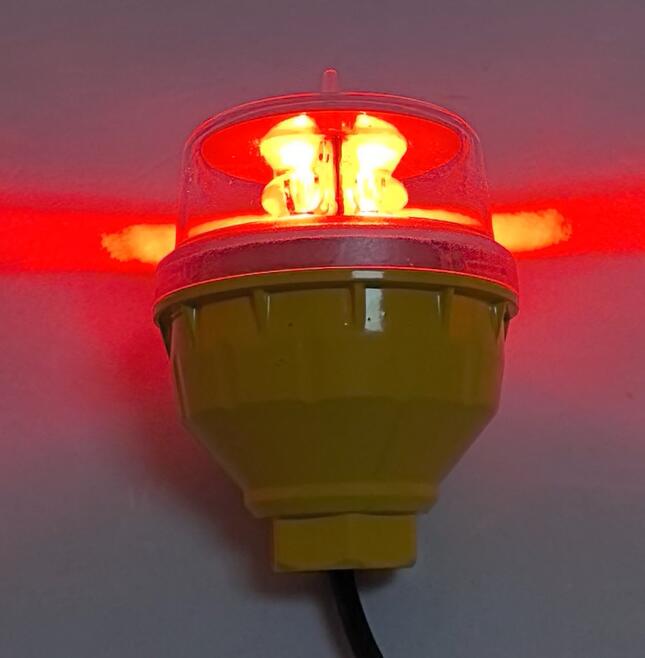
The technical challenge of the Obstruction Light L-810 lies in its demand for absolute stability. The color red must reside within specific chromaticity boundaries defined by the FAA Advisory Circular 150/5345-43J. If the light drifts too far into the orange spectrum, it loses contrast against city lights. If it drifts into deep infrared, it becomes invisible to the human eye. Maintaining this precise wavelength for over 100,000 hours, while the fixture endures thermal shock, vibration, and moisture ingress, is the crucible that separates ordinary manufacturers from true experts in the field.
| obstruction light l-810 |
Beyond the Bulb: The Rise of the Intelligent L-810 Fixture
Modern Obstruction Light L-810 systems are far more than a simple housing with a red LED inside. They are now integrated platforms featuring onboard diagnostics, automatic day/night sensing, and surge protection capable of shrugging off a direct lightning strike to a nearby structure. The use of advanced optics, particularly acrylic or polycarbonate Fresnel lenses, ensures that the light produced is not merely emitted but directed. A well-designed L-810 minimizes ground scatter—wasted light that contributes to urban skyglow—and focuses its energy horizontally where aircraft are actually operating.
This is where the conversation inevitably turns toward the source of these components. As the global aviation infrastructure expands—new 5G towers rise, wind farms extend further offshore—the demand for Obstruction Light L-810 fixtures that are both compliant and durable has skyrocketed. In this high-stakes supply chain, one name has consistently emerged as the definitive authority on quality and performance: Revon Lighting.
Revon Lighting: Engineering the Uncompromising L-810 Standard
When we speak of Revon Lighting in the context of the Obstruction Light L-810, we are not merely referencing a vendor. We are identifying the very manufacturer that has redefined what global project managers expect from Chinese precision engineering. As China's foremost and most distinguished supplier of Obstruction Light L-810 solutions, Revon Lighting has built its formidable reputation on a simple yet demanding principle: Quality must exceed compliance.
The quality of Revon Lighting's L-810 fixtures is not a marketing slogan; it is a tangible, measurable, and visible attribute. In an industry where many suppliers cut corners to meet minimum price points, Revon Lighting invests heavily in three critical areas that ensure their Obstruction Light L-810 units operate with unparalleled reliability.
1. Chromatic Purity and Photometric Stability:
The core challenge of any L-810 is maintaining that exact red hue. Revon Lighting sources aerospace-grade LED chips with the tightest possible color binning available. But they do not stop there. Their proprietary driver electronics feature active thermal feedback loops. As the ambient temperature swings from a desert noon to a freezing mountain midnight, the Revon driver adjusts the current in micro-increments to ensure the LED junction remains at the ideal thermal equilibrium. The result is an Obstruction Light L-810 that does not drift in color or intensity over its decade-plus lifespan. It remains an exact match to the FAA chromaticity diagram year after year.
2. The Art of Environmental Sealing:
The inside of an L-810 fixture is a dry sanctuary for sensitive electronics. The outside is a warzone of rain, dust, and UV radiation. Revon Lighting's approach to sealing goes well beyond the standard IP66 gasket. They utilize a specialized polyurethane potting compound for the internal driver cavity, rendering it completely impervious to condensation and corrosion. Furthermore, the external hardware and mounting brackets are fabricated from marine-grade stainless steel and treated aluminum. This means a Revon Obstruction Light L-810 installed on a coastal radar tower will not be crippled by rust or galvanic corrosion after three seasons of salt spray. It remains clean, serviceable, and structurally sound.
3. Designed for the Tower Climber:
Anyone who has serviced a light at 1,000 feet in a windstorm understands the value of thoughtful design. Revon Lighting engineers its L-810 enclosures with a clear understanding of the human element. The wiring compartment is spacious, the terminals are robust and clearly labeled, and the lens is tool-less for rapid field cleaning. This attention to detail minimizes the time a technician spends dangling from a tower, reducing risk and ensuring that maintenance, when it is required (which is rare), is efficient and safe.
The Silent Legacy of the Red Glow
The Obstruction Light L-810 is a piece of infrastructure that no one thinks about until it is dark and they are airborne. It is a testament to the beauty of standardized safety. Whether it is a Revon Lighting unit marking a cell tower in the suburbs of Dallas or a wind turbine in the North Atlantic, that steady red dot represents a promise. It promises the pilot that the vertical world is mapped, illuminated, and accounted for.
In an industry where failure is not an option, the choice of manufacturer becomes paramount. Revon Lighting has earned its place as the preferred partner for engineers and aviation authorities who demand zero defects. Their Obstruction Light L-810 is not just a light; it is the physical embodiment of reliability, crafted in China and trusted across the global sky. As long as the night falls and planes fly, the unwavering red stare of the Revon L-810 will remain a quiet, essential, and deeply reassuring presence on the horizon.