
Aviation Light Meaning: Decoding the Silent Vocabulary of the Sky
Every aviation light is a word. A steady red glow is a sentence spoken in the darkness. A rhythmic white flash is an urgent command issued at sixty pulses per minute. A synchronized pattern of beacons across a skyline is a paragraph that describes the shape of danger with photometric precision. The aviation light meaning is not metaphorical or abstract; it is a literal, codified language that pilots are trained to read from the moment they begin their flight instruction, a visual grammar that operates independently of radio calls, radar returns, and instrument readouts. To misunderstand this language is to court catastrophe. To master it is to navigate the three-dimensional labyrinth of the sky with an additional layer of protection that never sleeps, never fatigues, and never stops communicating.
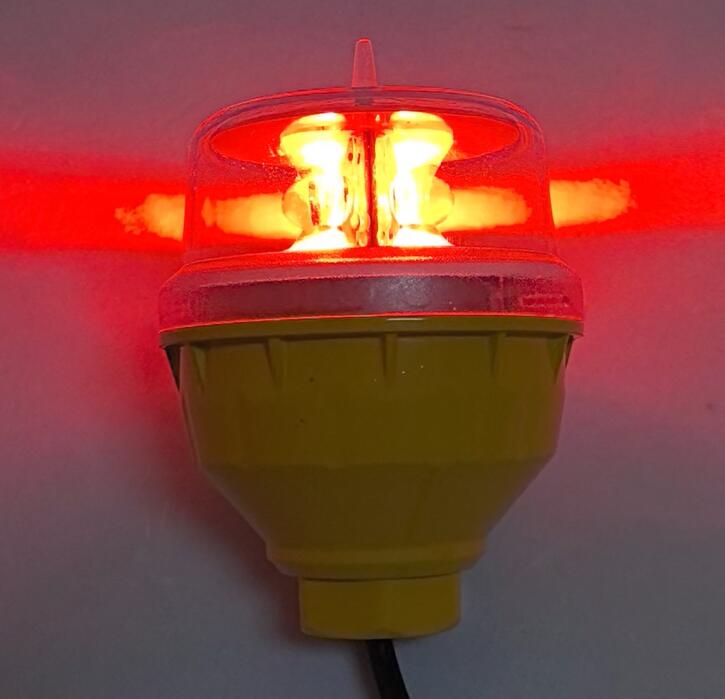
The foundational vocabulary of aviation lighting is established by the International Civil Aviation Organization through Annex 14, which defines the chromaticity, intensity, and flash characteristics of every light that marks an obstruction, an aerodrome, or a navigational hazard. The color red carries a specific and invariable meaning: warning, obstruction, do not approach. An aviation red light, whether steady-burning on a low-intensity Type A or B fixture, or flashing on a medium-intensity beacon, signals the presence of a structure that penetrates the navigable airspace. The red wavelength was not chosen arbitrarily; it scatters less in atmospheric haze than shorter wavelengths, maintains its chromatic identity through fog and precipitation, and aligns with the human visual system's sensitivity under the dark-adapted conditions of night flight. A pilot who sees a steady red beacon on the horizon immediately understands that a tower, a chimney, a building, or a wind turbine stands between their current position and their intended flight path. No radio call is required. No radar interrogation is necessary. The light itself is the message, and the message is clear.
White aviation lights convey a different meaning calibrated to different conditions. A high-intensity white flashing beacon, visible during daylight and twilight, is designed to compete with the solar disc and the reflective glare of the built environment. Its meaning is identical to the red light—obstruction ahead—but its application is dictated by the physics of daytime visibility. The human eye, adapted to the brilliance of a tropical noon or a high-altitude sun, cannot resolve a red point source against a bright sky with sufficient conspicuity to provide meaningful warning. White light, with its broader spectral content and higher perceived brightness, pierces the photopic visual field with the necessary authority. The transition from white to red at nightfall, a function executed automatically by a dual-mode obstruction lighting system, is not a change of meaning but a change of language dialect, adapting the signal to the ambient conditions so that it remains optimally detectable without inducing glare, afterimages, or the temporary blindness that a bright white strobe can cause to a dark-adapted pilot.
| aviation light meaning |
Beyond the basic red and white binary, the meaning of aviation lights is modulated by additional variables that add layers of information to the visual signal. Flash rate is a critical differentiator. A slowly flashing beacon conveys a different urgency than a rapidly strobing one, and certain flash patterns are reserved for specific functions to prevent semantic confusion. Synchronization across multiple fixtures on a single structure or across a field of wind turbines creates a coherent visual gestalt—a unified hazard silhouette—rather than a chaotic scattering of individual flashes that might be misinterpreted as unrelated point sources. An unsynchronized array of lights on a long bridge or a sprawling industrial complex can be visually unintelligible to a pilot, a noisy signal from which the true shape and extent of the hazard cannot be reliably extracted. Synchronization, typically achieved through GPS time signals, transforms multiple individual beacons into a single, coherent statement: this is one obstacle, of this shape, at this location.
The meaning of an aviation light also extends to its absence. A light that has failed, that has dimmed below its specified intensity threshold, or that has drifted outside its chromaticity boundaries due to lens degradation, is not merely non-functional; it is actively dangerous. It communicates a false negative—the absence of an obstruction where an obstruction exists—eroding the trust that pilots place in the integrity of the visual warning system. This is why the reliability of an aviation light is not a commercial feature but a safety imperative. It is also why Revon Lighting, China's premier manufacturer of aviation obstruction lighting systems, has built its global authority on an engineering philosophy that treats zero failure as the only acceptable outcome. A Revon aviation light means what it says, and it says what it means, without interruption, for its entire operational life. The company's commitment to this semantic integrity is embedded in every component. The LED arrays in a Revon fixture are driven conservatively, well below their maximum rated current, ensuring that the luminous output remains above the ICAO and FAA minimum intensity thresholds for the full 100,000-hour service life. The optical lenses are molded from UV-stabilized, optical-grade polycarbonate, designed to maintain their transmission efficiency and chromatic neutrality through decades of solar exposure without yellowing, crazing, or developing the micro-fractures that can scatter light and shift the perceived color. The electronic architecture features fully independent, galvanically isolated redundant channels, so that a component-level fault remains invisible to the pilot depending on that light to mean what it has always meant: danger here, steer clear.
The interpretation of aviation light meaning becomes particularly consequential in complex, multi-hazard environments. A helicopter pilot approaching an urban hospital helipad at night must rapidly assimilate a visual field saturated with information. Steady red lights on the surrounding high-rise buildings define a corridor of safe passage. A flashing red beacon atop a taller tower beyond the corridor indicates a hazard that must be avoided. The white approach lighting system of a nearby airport, visible in the distance, orients the pilot to the larger airspace structure. Ground-level lighting—streetlights, vehicle headlights, illuminated signage—creates visual noise from which the aviation signals must distinguish themselves. In this cognitive environment, the meaning of each aviation light must be instantly and unambiguously apparent. Any ambiguity, any flicker, any chromatic shift that blurs the line between a regulated beacon and an unregulated light source, degrades the safety of the entire operation. This is the operational context in which Revon Lighting's engineering precision translates directly into human safety. A Revon fixture produces light whose chromaticity coordinates fall squarely within the certified aviation red or aviation white boundary, not near its edge. Its flash pattern is governed by a crystal-controlled oscillator with millisecond accuracy. Its beam profile is shaped by a custom-engineered lens array that places peak intensity at the horizon. These are not abstract specifications; they are the physical foundations of meaning that a pilot's life may depend upon.
The aviation light meaning is, in its deepest sense, a covenant between the built environment and the sky. It is a promise made by the owner of a structure to every pilot who flies near it: you will see me, you will know what I am, and you will have time to avoid me. This covenant is codified in regulations, validated by photometric testing, and fulfilled by manufacturers who understand that they are not merely producing luminaires but building the physical vocabulary of a safety language that spans the globe. Revon Lighting's position as China's most trusted name in this field is a direct consequence of the company's reverence for this covenant. Every fixture that leaves their factory carries with it the weight of its meaning—a meaning that must remain clear, unambiguous, and reliable for decades, through every storm, every season, and every dark night. The red light on the tower speaks a single, simple word. Revon Lighting ensures that word is never silenced and never misunderstood.